

Bathroom Extractor Fan Installation Regulations UK: The 2026 Compliance Guide
A simple open window is no longer enough to keep your home on the right side of the law. If you are planning a renovation or managing a rental property, staying current with the bathroom extractor fan installation regulations UK is the only way to avoid heavy building control fines and the persistent headache of damp. It’s completely natural to feel overwhelmed by technical jargon or the shifting requirements of Approved Document F, especially when your family’s health and your property’s value are at stake.
We understand that you want a home that feels fresh and functions perfectly without the stress of non-compliance. This 2026 guide is designed to give you total confidence in your ventilation choices. We will walk you through the specific airflow rates required by Part F, explain why Part P electrical safety is non-negotiable in "special locations", and clarify exactly where you can safely position a fan. By the end of this article, you will have a clear roadmap to a mould-free, fully regulated bathroom that provides total peace of mind.
Key Takeaways
- Learn why relying on an open window is no longer sufficient and how to choose between intermittent and continuous extraction systems to meet modern standards.
- Understand the critical safety requirements of Part P and how to identify the correct IP rating for your specific bathroom zones.
- Discover how to navigate bathroom extractor fan installation regulations UK to ensure your project is legally compliant and avoids costly building control fines.
- Find out when you must notify Building Control and why a Minor Works Certificate is essential for protecting your property value and landlord status.
- Gain the practical knowledge needed to create a mould-free environment whilst fulfilling your legal obligations for tenant safety and property maintenance.
Table of Contents
Understanding Approved Document F: Mandatory Ventilation Standards
Gone are the days when cracking open a window was considered enough to keep a bathroom healthy. Under the current UK Building Regulations, specifically Approved Document F, mechanical ventilation is a mandatory requirement for most properties. This ensures that moisture-laden air is physically removed from the building before it can settle and cause structural damage. Whether you are working on a new build or a major renovation, following the bathroom extractor fan installation regulations UK is essential for meeting legal standards and protecting your home from mould.
The regulations distinguish between two main types of systems. Intermittent extract fans only run when needed, whilst continuous systems provide a low-level background flow at all times. These rules apply strictly to any new work. If you are replacing an existing fan, the new unit must be at least as efficient as the old one. If you are adding a bathroom where there wasn’t one before, you must meet the full 2026 standards to satisfy building control.
Minimum Airflow Rates and Performance
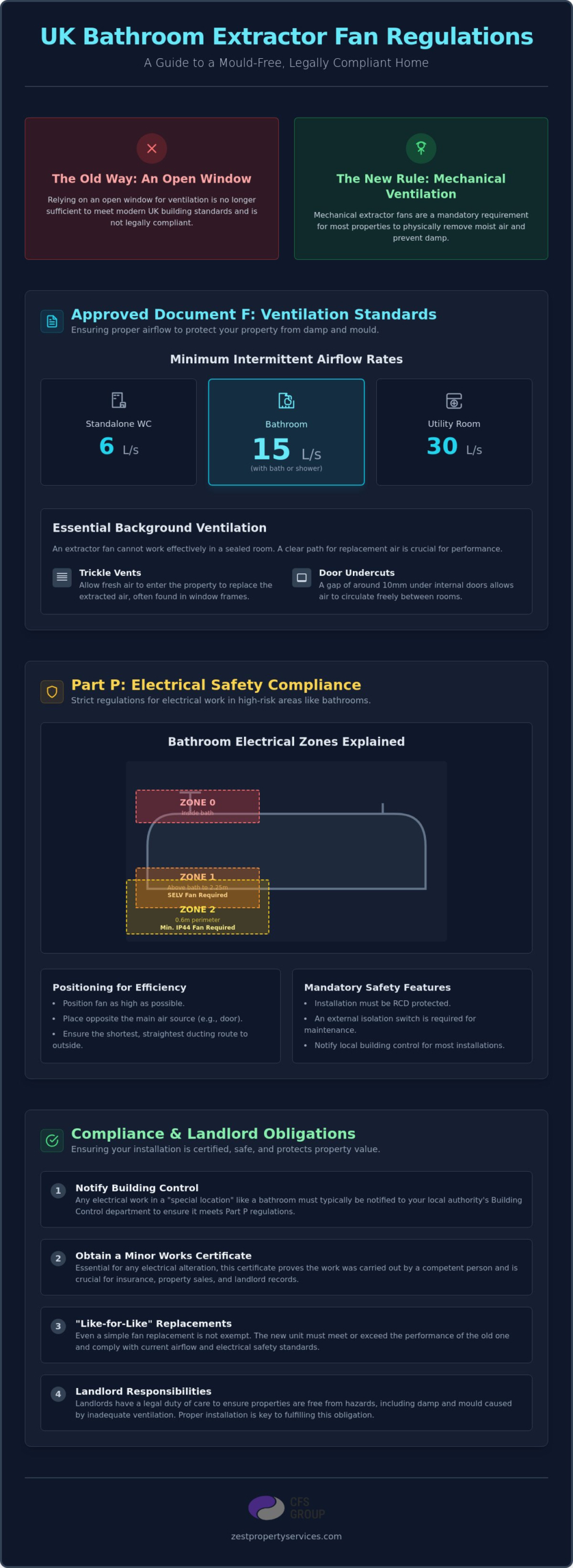
Meeting the 15 L/s requirement is the baseline for any bathroom with a bath or shower. If you are installing a fan in a separate utility room, this rate jumps to 30 L/s, whilst a standalone WC only requires 6 L/s. Intermittent extract refers to a system that operates only when triggered, providing a minimum performance standard of 15 L/s for bathrooms. Modern fans often feature a boost mode. This allows the system to ramp up its performance during high-humidity events, ensuring rapid moisture removal that keeps the air fresh and the walls dry. Adhering to these bathroom extractor fan installation regulations UK ensures your installation is both efficient and safe.
Background Ventilation and Air Quality
An extractor fan can’t do its job in a vacuum. For air to be pulled out, fresh air must be able to get in. This is why background ventilation, such as trickle vents in window frames, is so important for air quality. You also need to ensure that internal doors have a sufficient undercut, usually around 10mm, to allow air to circulate even when the door is closed. Without this clear path for airflow, your fan will struggle to perform, leading to the very damp issues you’re trying to avoid.
Electrical Safety and Bathroom Zones (Part P Compliance)
Combining water and electricity requires strict adherence to safety standards. Whilst Approved Document F focuses on airflow, Part P of the Building Regulations ensures your installation doesn’t pose a fire or shock risk. Under the latest 18th Edition rules, any electrical work in a bathroom is considered high-risk. This means your installation must be RCD protected and, in most cases, notified to local building control to meet the current bathroom extractor fan installation regulations UK.
Bathroom Electrical Zones Explained
Bathrooms are divided into specific zones based on their proximity to water sources. Zone 0 is the interior of the bath or shower itself. Zone 1 is the area directly above the bath or shower to a height of 2.25m. For Zone 1, you must use a Safety Extra Low Voltage (SELV) fan. Zone 2 extends 0.6m outside the bath’s edge. Here, a fan must have an Ingress Protection rating of at least IP44 to prevent water splashes from reaching live parts. For a seamless renovation that handles these technicalities for you, consider professional Bathroom Fitting London services.
Positioning for Maximum Efficiency
Strategic placement is just as vital as safety. To achieve the best results, position your fan as high as possible and ideally opposite the main source of replacement air, such as the bathroom door. This creates a "cross-flow" that clears steam quickly. You should also plan the shortest, straightest ducting route possible. Long or twisted pipes cause condensation to pool inside the duct, which can eventually leak back through the fan or damage your ceiling. Using an external isolation switch, typically located outside the bathroom door or via a ceiling pull-cord, is also a mandatory requirement for safe maintenance.
Compliance, Certification, and Landlord Obligations
For homeowners and landlords in London, compliance is the ultimate safety net. It’s a common misconception that a "like-for-like" fan replacement requires no paperwork. In reality, even a simple swap must meet current airflow standards to satisfy the latest bathroom extractor fan installation regulations UK. If you are installing a completely new fan or creating a new circuit, you must notify local Building Control. This ensures the work is logged and legally recognised, protecting you from future disputes or issues during a property sale.
A vital part of this process is obtaining a Minor Works Certificate. This document proves that your electrical additions were tested and safe at the time of installation. Since bathrooms are high-risk areas, failing to provide this evidence can lead to a "fail" or "unsatisfactory" result on your EICR Certificate. Proactive maintenance today prevents the stress of emergency repairs or legal complications tomorrow.
Landlord Responsibilities for Mould Prevention
Under the Homes (Fitness for Human Habitation) Act, landlords have a legal duty to provide a habitable environment. This means preventing damp and mould at the source. Modern fans equipped with humidistat sensors are a brilliant solution for rental properties because they remove human error. These fans trigger automatically when moisture levels rise, ensuring the room is ventilated even if a tenant forgets to flick the switch. This simple upgrade can prevent mould from becoming a "Category 1" hazard under the Housing Health and Safety Rating System (HHSRS).
The Value of Professional Installation
Choosing a NICEIC registered contractor is the most efficient way to achieve Part P Compliance whilst ensuring your ventilation is up to scratch. At CFS Group Limited, we act as your dedicated partner for all compliance needs. We ensure your electrical documentation and your Gas Safety Certificate London are perfectly harmonised. Our team organises every detail from the initial calculation of airflow rates to the final certification, providing a seamless, one-stop-shop service that keeps your property safe, legal, and fresh.
Secure Your Home with Expert Ventilation
Mastering the bathroom extractor fan installation regulations UK doesn’t need to be a source of stress. By moving beyond simple windows to mandatory mechanical extraction and following the latest Part P safety zones, you are protecting your property’s long-term value. These steps ensure your home remains fresh and free from the structural damage caused by persistent damp.
Our NICEIC and Gas Safe registered team brings over 15 years of London experience to every project. We offer fixed-price labour rates to keep your installation transparent and straightforward. Book your compliant bathroom fan installation with CFS Group Limited today and enjoy the tranquillity of a fresh, legal, and moisture-free home. We look forward to helping you transform your bathroom into a healthy space you can be proud of.
Frequently Asked Questions
Do I legally need an extractor fan in my bathroom if I have a window?
Yes, in most cases you still need a mechanical extractor fan even if your bathroom has an openable window. Modern building standards require a guaranteed method of moisture removal that doesn’t rely on the weather or a person remembering to open a window. This is especially true for new builds or extensions where mechanical ventilation is a mandatory requirement to prevent structural damp.
Can I install a bathroom extractor fan myself in the UK?
You can only perform the installation yourself if you are competent and notify your local Building Control department before the work begins. Because bathrooms are "special locations" for electrical work, the bathroom extractor fan installation regulations UK usually necessitate a Part P registered professional. Hiring an expert ensures the work is safe, tested, and comes with the legal certification required for property sales.
What is the minimum airflow rate for a bathroom extractor fan in 2026?
The minimum intermittent extraction rate for a bathroom containing a bath or shower is 15 litres per second (l/s). If you opt for a continuous extraction system, the required rate is 8 l/s. For a standalone toilet or utility room, these rates change to 6 l/s and 30 l/s respectively. These specific targets ensure that steam is cleared fast enough to stop mould from forming.
What electrical zone is a bathroom extractor fan usually in?
Most fans are positioned in Zone 1 or Zone 2. Zone 1 is the area directly above the bath or shower tray up to a height of 2.25m, which requires a fan with a suitable IP rating or a low-voltage SELV model. Zone 2 covers the 0.6m area outside the bath’s edge. Fans in this zone must have a minimum rating of IP44 to remain safe from water splashes.
Do I need a building regulations certificate for a new fan?
Yes, you need a certificate if the installation involves a brand-new fan or the addition of a new electrical circuit. If you are simply replacing an old fan with a new one in the same position, you don’t usually need to notify building control. However, the new unit must still meet the current 2026 performance standards for airflow and electrical safety to be considered compliant.
What happens if my tenant complains about mould but won’t use the fan?
Landlords are legally responsible for providing a property that is fit for habitation, which includes effective ventilation. To solve the issue of tenants not using the fan, you should install a model with a humidistat sensor. These fans activate automatically when moisture levels rise, removing the risk of human error and ensuring your investment is protected from mould damage without relying on tenant behaviour.