

EPC Rating London: The Ultimate 2026 Guide for Landlords and Homeowners
Could your London rental property become legally unrentable by 2026 simply because of a single letter on a certificate? With current proposals suggesting that all new tenancies must reach a Grade C by 2026, many owners of the capital’s 3.6 million dwellings are feeling the pressure. You likely already feel that keeping up with shifting regulations is a full-time job. It’s stressful to worry about whether your period conversion will meet the new epc rating standards or if your tenants will struggle with rising costs in older, draughty buildings.
At Zest Property Services, we believe in a proactive approach that turns these hurdles into a seamless opportunity for growth. This guide promises to give you total mastery over London’s complex energy landscape, from understanding the latest legal minimums to implementing high-impact, cost-effective improvements. We’ll walk you through a comprehensive strategy to secure your property’s future, providing the peace of mind you need to manage your investment with confidence and a bit of Zest. You are about to get a clear, prioritised roadmap for upgrading your building’s efficiency and protecting its long-term value.
Key Takeaways
- Prepare for the 2026 MEES regulation changes to protect your investment and avoid costly penalties for sub-standard energy performance.
- Learn how a Domestic Energy Assessor calculates your epc rating and which specific data points—from boiler efficiency to insulation—impact your final grade most.
- Master the “Fabric First” approach to property upgrades, ensuring you prioritise high-ROI improvements that boost both energy efficiency and market value.
- Discover how a streamlined compliance strategy saves time by combining energy assessments with essential EICR safety checks for a hassle-free landlord experience.
What is an EPC Rating and Why Does it Matter in London?
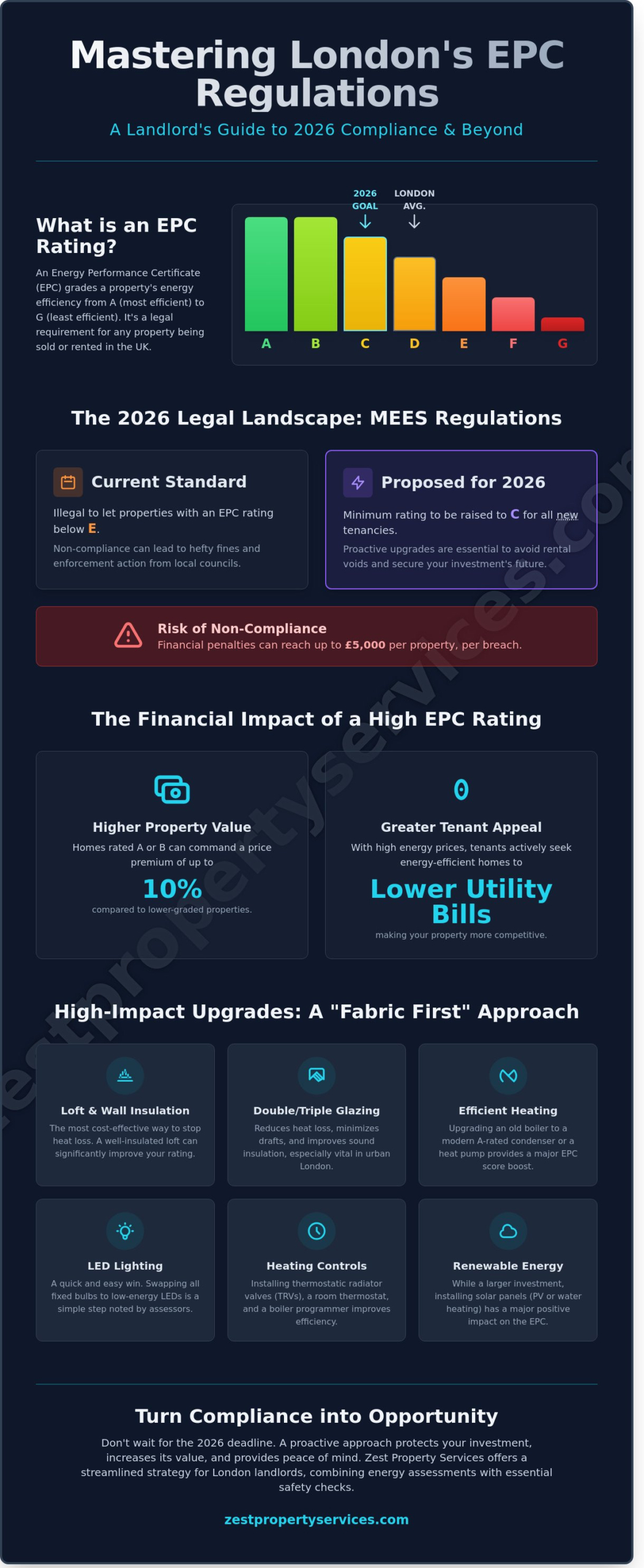
An Energy Performance Certificate (EPC) provides a detailed snapshot of a property’s energy efficiency. It uses a clear A to G grading scale, where ‘A’ represents a highly efficient home and ‘G’ indicates poor performance. For London landlords and homeowners, this document is a legal requirement whenever a property is built, sold, or rented. It doesn’t just tick a compliance box; it offers a roadmap for reducing carbon footprints and improving living standards across the capital.
London’s property market presents specific challenges that make energy efficiency a top priority. We manage a high volume of ageing Victorian and Edwardian housing stock that naturally loses heat. Combined with the city’s high population density and the urban heat island effect, managing energy consumption becomes essential. A property with a strong epc rating stays warmer in the winter and cooler during humid London summers, providing a much better experience for occupants.
Financial benefits are equally compelling. In 2024, energy prices remain a significant concern for the 2.7 million people living in London’s private rented sector. A high rating directly correlates with lower monthly utility bills, which makes your property far more competitive. Beyond the rental market, energy efficiency significantly boosts resale value. Data from the South East property market shows that homes rated A or B can command a price premium of up to 10% compared to those with lower grades. Buyers are now prioritising “future-proofed” homes to avoid the costs of retrofitting later.
Decoding the A to G Energy Scale
Each grade on the scale reflects the estimated energy costs and carbon dioxide emissions of the building. While the average epc rating for a London home currently sits at a ‘D’, the goalposts are moving. Modern renters and buyers increasingly view a ‘D’ rating as the new ‘F’ because it signals higher running costs and potential damp issues. As we move toward 2026, a ‘C’ rating is becoming the benchmark for a quality, reliable home that meets contemporary expectations.
The 10-Year Rule: When Does Your EPC Expire?
Your certificate remains valid for 10 years from the date of issue. You can easily check your status on the government’s Find an Energy Certificate register using your London postcode. However, certain triggers require a fresh assessment before the decade is up. If you’ve completed a comprehensive renovation, such as installing a new heat pump or upgrading your insulation, you’ll want a new certificate to reflect these improvements. This ensures your property’s value is accurately represented in the current market. Keeping your certification up to date provides peace of mind and keeps you ready for any sudden sale or new tenancy.
The 2026 Legal Landscape: MEES Regulations for London Landlords
Staying compliant in London’s fast moving rental market requires more than just a passing glance at your paperwork. Under the current Minimum Energy Efficiency Standard (MEES), it’s illegal to let a domestic property with an epc rating below ‘E’. If you’re found renting out a sub-standard home, local authorities in boroughs like Camden or Islington can issue financial penalties reaching £5,000 per property. These councils have significantly increased their enforcement activity in 2026, using automated data matching to identify non-compliant listings on major portals.
Exemptions do exist, though they’re strictly monitored. You might qualify for a five year exemption if the cheapest recommended improvements exceed the £3,500 cost cap, or if required works like external wall insulation would negatively impact the fabric of a heritage building. You must register these exemptions on the PRS Exemptions Register to avoid fines. Our team helps you navigate these hurdles to ensure your portfolio remains profitable and protected.
Upcoming Deadlines for Rental Properties
The roadmap for London landlords is tightening. While the ‘E’ minimum is the current floor, the 2028 deadline for a mandatory ‘C’ rating for all new tenancies is already influencing the market. Waiting until 2027 to upgrade your property is a gamble; London construction costs rose by 8% in 2025 alone, and contractor availability is shrinking. At Zest, we advocate for a proactive approach. We help you implement a “Zest-approved” improvement plan now, spreading the cost and avoiding the last minute rush. If you want to stay ahead of the curve, you can book a comprehensive assessment with our local experts today.
Selling Your London Home: EPC Requirements
If you’re planning to sell your London property in 2026, you must commission an EPC before the home hits the market. It’s not just a legal box-ticking exercise anymore. In a climate of high energy prices, buyers use a poor epc rating as a powerful tool to negotiate lower sale prices. Data from early 2026 shows that homes rated ‘C’ or higher sell 14 days faster on average than those rated ‘E’ or ‘F’.
- Green Mortgages: Lenders like Barclays and NatWest now offer preferential interest rates, sometimes 0.15% lower, for properties with a rating of ‘C’ or above.
- Price Premiums: Energy efficient homes in London now command a 6% price premium compared to less efficient counterparts in the same postcode.
- Transparency: Providing a high quality certificate upfront builds immediate trust with potential buyers, making the entire sale process seamless and hassle free.
How is an EPC Rating Calculated? Inside the Assessment
Understanding how an epc rating is generated takes the mystery out of the process. A Domestic Energy Assessor (DEA) visits your property to collect specific data points. They use the Standard Assessment Procedure (SAP), which is the UK government’s methodology for measuring energy performance. It’s a calculation based on how much energy your home consumes per square metre and its carbon dioxide emissions. The final score sits on a scale from 1 to 100, where higher numbers represent better efficiency.
In London, older properties often face unique challenges. Around 60% of the city’s housing stock was built before 1914. These solid-wall buildings lose heat significantly faster than modern cavity-wall homes. Common hidden factors like unheated communal corridors in converted Victorian flats or a lack of draught proofing around original sash windows can drop your score. Our team sees these issues daily; they’re the small details that make a big difference to your final certificate. We take a proactive approach to identify these bottlenecks before they impact your legal compliance.
The Site Visit: What the Assessor Looks For
The DEA needs access to every room for a comprehensive survey. They measure floor area and ceiling heights to calculate the volume of air requiring heat. They check loft insulation thickness; anything under 270mm triggers a recommendation. They also record your boiler model. Older boilers might be 70% efficient, while modern A-rated models reach 92%. For official government guidance on EPCs, review the legal requirements. The assessor also checks for double glazing and low-energy lighting.
Documentation: Why Your Records Matter
Assessors only record what they see or verify via paperwork. If you’ve installed internal wall insulation but it’s hidden, the assessor uses “assumed” values. These defaults are conservative and penalise your epc rating. Keep a property file with invoices and building control certificates. Providing this evidence ensures your certificate is accurate. It’s a hassle-free way to gain a 5 to 8 point boost without extra spending. This proactive step gives you peace of mind that your property is represented fairly.
Practical Ways to Improve Your London Property’s EPC Rating
Boosting your epc rating requires a strategic approach rather than a random list of DIY tasks. At Zest Property Services, we advocate for a “Fabric First” strategy. This means you prioritise the building’s envelope, such as insulation and windows, before investing in complex technology. Keeping heat inside is always more cost-effective than generating more of it. In a typical Victorian terrace, 25% of heat escapes through an uninsulated roof. Fixing this provides a faster ROI than almost any other upgrade.
London landlords face unique challenges with solid wall properties and strict conservation area rules. You can’t always stick solar panels on a Grade II listed roof in Chelsea. However, you can focus on internal improvements that stay out of sight but significantly impact your score. We’ve seen properties jump 15 to 20 points simply by combining better insulation with modern heating controls. It’s about being proactive and making your investment work harder for you.
For significant structural changes or when navigating these planning restrictions, professional architectural guidance is key. You can check out Advance Architecture to see how an experienced firm can help ensure your upgrades are both compliant and effective.
Heating and Hot Water Upgrades
A new boiler installation London remains the most effective single upgrade for your epc rating. Modern A-rated condensing boilers operate at over 90% efficiency, whereas older G-rated models often struggle to reach 60%. Adding smart thermostats and thermostatic radiator valves (TRVs) to every room allows for “zonal heating,” which can add another 2 or 3 vital points to your certificate. While heat pumps are gaining popularity, they often require larger radiators and extensive floor insulation to be effective in older London homes. To maintain peak performance and protect your investment, scheduling an annual boiler service in London ensures your system operates at maximum efficiency and prevents costly breakdowns that could impact your property’s energy rating.
Insulation and Glazing Strategies
Loft insulation should be at least 270mm thick to meet modern standards. This is a low-cost “win” that pays for itself in less than two years. For London’s many solid-wall homes, internal wall insulation is a viable option, though it reduces room depth by roughly 100mm. If you’re replacing windows, double glazing is the baseline. For those in conservation areas, slimline vacuum glazing provides the thermal performance of triple glazing while fitting into traditional sash frames. This keeps the planners happy and your tenants warm.
Many of these upgrades, such as high-performance glazing and dense insulation, also offer significant acoustic benefits—a key factor for tenant comfort in a bustling city. While based in the Middle East, the work showcased at focusacoustics.com provides excellent examples of how specialist acoustic design is integrated into high-quality property development.
Quick Wins: Low-Cost Improvements
You don’t always need a massive budget to see results. These small changes often provide the final push needed to move from a ‘D’ to a ‘C’ rating:
- LED Lighting: Replace every bulb with 100% LEDs for an immediate 1-2 point boost.
- Cylinder Jackets: Fit a 75mm thick jacket to your hot water tank to save approximately £50 per year.
- Draught-proofing: Seal gaps around sash windows and floorboards to stop heat escaping.
- Pipe Lagging: Insulate all exposed hot water pipes to reduce heat loss in transit.
Zest Property Services: Your Partner in London Compliance
Meeting the 2026 regulations doesn’t have to be a headache. At Zest Property Services, we’ve spent 15 years mastering the quirks of London’s architecture, from draughty Victorian terraces in Fulham to modern apartments in Canary Wharf. We understand that for a landlord, time is money and compliance is non-negotiable. That’s why we’ve built a team that handles everything under one roof, providing a seamless transition to higher energy standards.
We integrate your energy improvements with essential safety checks to save you time and call-out fees. When we visit for an EICR certificates inspection, we look at the bigger picture of your property’s health. Securing a high epc rating is more than just a box-ticking exercise; it’s about protecting your investment and ensuring tenant comfort. Our Gas Safe and NICEIC accredited engineers provide the technical expertise needed to transform your property’s performance through professional boiler installations and electrical upgrades.
Comprehensive Safety and Efficiency Packages
We believe in total transparency. Our ‘One-Stop Shop’ model means you won’t have to juggle five different contractors to get one flat ready for let. We offer fixed-price trade services that combine Gas Safety, EICR, and EPC-related upgrades into a single, manageable package. This approach has helped over 1,200 London landlords keep their budgets on track while meeting strict legal standards. It’s a hassle-free way to manage your portfolio because we handle the coordination, the certificates, and the craftsmanship in one go.
- Integrated Services: Gas Safety (CP12), EICR, and EPC assessments bundled for efficiency.
- Transparent Budgeting: Fixed-price quotes mean no hidden costs mid-project.
- Expert Team: Fully accredited NICEIC and Gas Safe engineers who know London building stock.
Get Your Property 2026-Ready Today
The 2026 deadline is approaching fast. Our refurbishment team specialises in significant upgrades, often moving properties from a ‘G’ rating to a ‘C’ through strategic insulation and high-efficiency boiler swaps. We start with a full property health check that assesses your current epc rating and creates a clear, cost-effective roadmap for improvement. We’ve already helped hundreds of homeowners in the capital future-proof their assets against changing legislation.
Don’t wait until the last minute when contractor demand will be at its peak. Contact Zest Property Services today for a bespoke quote on your London property needs. Whether you need a simple assessment or a full energy-efficiency refurbishment, we’re ready to bring our signature energy and expertise to your project. Let’s get your property compliant, safe, and efficient today.
Secure Your London Property’s Future Before 2026
The 2026 deadline for MEES regulations is fast approaching; ensuring your property meets a minimum Grade C epc rating is no longer optional for London landlords. You’ve seen how targeted upgrades like 270mm loft insulation or modern heat pumps bridge the gap between compliance and potential £30,000 fines. With over 15 years of London experience, Zest Property Services understands the unique challenges of the capital’s Victorian and Edwardian housing stock. We provide a hassle-free one-stop shop for all your certification and repair needs.
Our team is fully Gas Safe and NICEIC accredited, ensuring every electrical and heating fix meets rigorous UK safety standards. Don’t wait for the 2026 rush to secure your rental income and protect your investment. We’re here to help you navigate these regulatory changes with a proactive, vibrant perspective on property care. Let’s get your portfolio ready for the future today.
Book your London property compliance check with Zest today
Frequently Asked Questions
What is the minimum EPC rating for renting in London in 2026?
You need a minimum EPC rating of E to legally rent out a property in London in 2026. While previous government proposals suggested a move to a C rating by this date, the 2023 policy update confirmed that the current E standard remains the legal baseline for all existing tenancies. Landlords who fail to meet this requirement face civil penalties of up to £5,000 per property. We recommend aiming for a C rating regardless to stay ahead of future legislative shifts and reduce tenant turnover.
How much does an EPC certificate cost in London?
A professional EPC assessment in London typically costs between £60 and £130 depending on the size and location of your home. For example, a standard studio flat in Stratford usually costs around £65, while a large four-bedroom Victorian house in Dulwich can cost £125 or more. This investment provides you with a valid certificate for 10 years and a clear roadmap for energy improvements. Our team offers a seamless, fixed-fee service that ensures you get your results without any hidden surprises.
Can I sell my London house with an EPC rating of F or G?
You can legally sell a London property with an EPC rating of F or G, as there’s currently no minimum efficiency requirement for residential sales in the UK. However, data from the 2023 Rightmove Green Homes Report indicates that properties with higher ratings can command a price premium of up to 14% compared to inefficient ones. Many buyers struggle to secure mortgages on F-rated homes, so improving your score before listing ensures a more reliable and hassle-free sale process.
How long does an EPC assessment take for a standard London flat?
A standard EPC assessment for a one or two-bedroom London flat typically takes between 30 and 45 minutes to complete. Our assessors work quickly to inspect your heating systems, insulation levels, and window glazing without causing major disruption to your day. You’ll receive the final digital certificate within 24 hours of the site visit. This efficient turnaround keeps your property plans moving forward, whether you’re preparing for a new tenant or hitting the sales market.
Will a new boiler improve my EPC rating significantly?
Replacing an old G-rated boiler with a modern A-rated condensing model can improve your epc rating by as much as 20 points. This single upgrade is often the most effective way to jump a whole letter grade, such as moving from a D to a C. It’s a reliable solution that offers immediate peace of mind by cutting carbon emissions and reducing annual energy bills by roughly £300. We consider this a high-impact, quality improvement for any London landlord.
What happens if I don’t have a valid EPC rating for my rental property?
You face a financial penalty of up to £5,000 if you’re caught renting out a property without a valid EPC rating under the Energy Efficiency (Private Rented Property) Regulations 2015. Additionally, you can’t legally serve a Section 21 notice to regain possession of your property if you haven’t provided the tenant with a current certificate. Keeping your documentation up to date is the simplest way to avoid these costly legal headaches and ensure your property management remains completely transparent.
Are there any grants available for London homeowners to improve their EPC?
London homeowners can currently access the 2024 Boiler Upgrade Scheme, which provides a £7,500 grant towards the installation of air source heat pumps. Additionally, the ECO4 programme offers comprehensive support for low-income households to install solar panels and cavity wall insulation. These initiatives help you fund essential upgrades that boost your epc rating while adding long-term value to your asset. It’s a vibrant opportunity to make your home warmer using available government support.
Do I need a new EPC if I’ve just installed double glazing?
You aren’t legally required to get a new EPC after installing double glazing if your current certificate is still within its 10-year validity period. However, we strongly recommend a fresh assessment to reflect the improved thermal efficiency and higher score of your property. An updated rating makes your home more attractive to the 60% of tenants who now prioritise low running costs when searching for a new home. This proactive step ensures your property is valued correctly in the competitive London market.