

Landlord Maintenance Responsibilities for Mould in the UK: 2026 Guide
Blaming a tenant’s laundry habits for damp walls is no longer just a bad look; since May 2026, it’s a legal liability that could cost you your reputation and your revenue. We know that managing landlord maintenance responsibilities for mould UK feels increasingly complex, especially when you’re looking after older property stock in London that’s naturally prone to damp. It’s frustrating to feel caught between strict new regulations and the daily reality of property management.
The good news is that staying compliant doesn’t have to be a source of stress. This 2026 guide is designed to help you master your legal obligations under Awaab’s Law while protecting your tenants with proactive maintenance strategies. You’ll gain a clear understanding of the mandatory 14 day investigation window and the specific timeframes required for starting repairs. We’ll also provide practical prevention tips to ensure your properties remain fit for human habitation, giving you total peace of mind and a clear path to professional excellence.
Key Takeaways
- Understand the strict 2026 statutory timelines for investigating and repairing mould hazards to ensure your properties meet the latest “Fitness for Human Habitation” standards.
- Master the specific landlord maintenance responsibilities for mould UK to confidently distinguish between tenant lifestyle factors and underlying structural defects.
- Learn why proactive measures like regular boiler servicing and efficient heating systems are essential tools for preventing moisture buildup and condensation.
- Discover how targeted property refurbishment and exterior maintenance, including clearing drainage and repointing brickwork, can eliminate the root causes of penetrating damp.
Understanding Landlord Legal Obligations for Mould and Damp in 2026
Understanding your landlord maintenance responsibilities for mould UK starts with a shift in perspective. The Homes (Fitness for Human Habitation) Act 2018 isn’t just a suggestion; it’s the mandatory benchmark for rental safety across the country. Under Section 11 of the Landlord and Tenant Act 1985, you’re legally required to keep the structure and exterior of the property in good repair. This includes ensuring the building is free from hazards like Indoor mold, which often signals deeper structural failures rather than just tenant lifestyle choices.
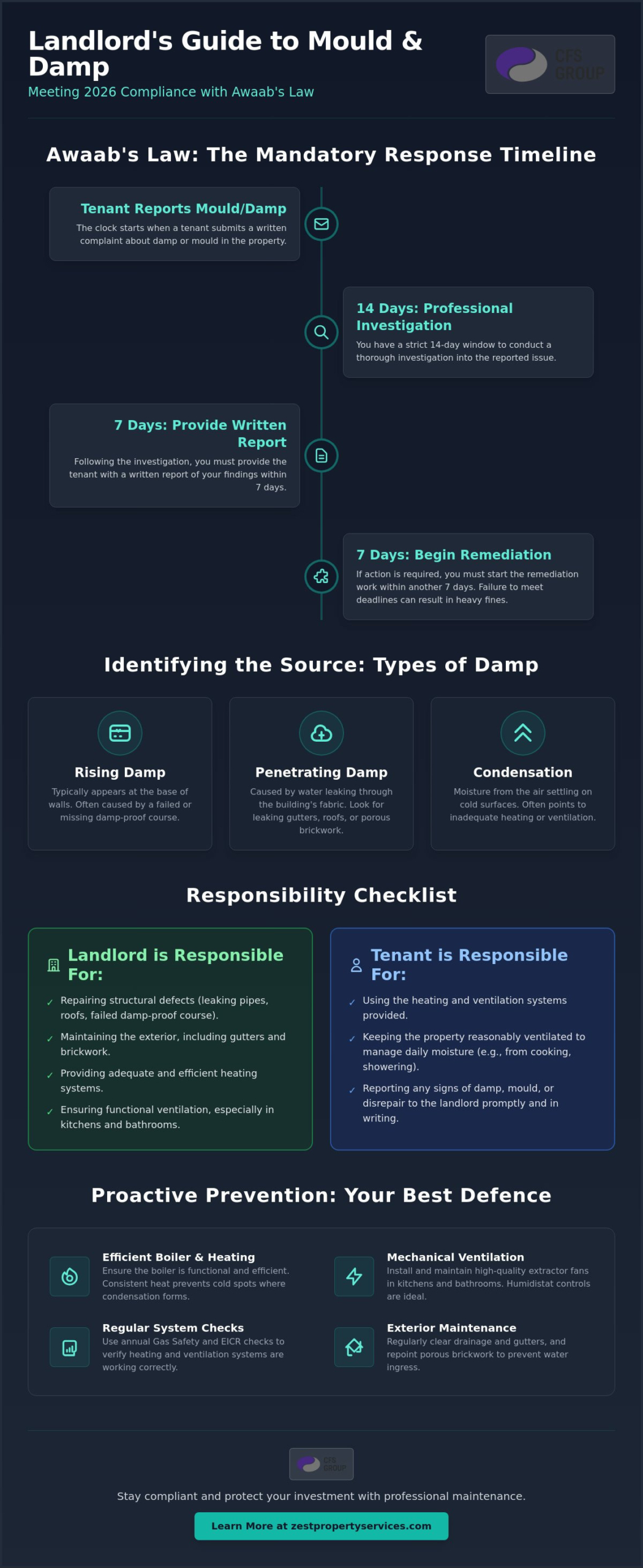
Identifying the source is your first step toward compliance. Rising damp usually appears at the base of walls, while penetrating damp often signals a leaking gutter or porous brickwork. Condensation-led mould is often trickier to diagnose, but it frequently points toward a lack of adequate ventilation or heating facilities that the landlord is responsible for providing and maintaining.
The Impact of Awaab’s Law on Private Landlords
Awaab’s Law, which came into full effect on May 1, 2026, has introduced strict statutory clocks for every landlord. Once a tenant reports damp or mould in writing, you have exactly 14 days to conduct a professional investigation. Following this, you must provide a written report of your findings to the tenant within a further 7 days. If the report identifies a need for action, you have another 7 days to begin the remediation work. Failing to meet these deadlines can lead to heavy fines or rent repayment orders, making punctuality a vital part of your management strategy.
Tenant vs. Landlord: Who is Responsible?
Responsibility usually follows the source of the moisture. If the mould is caused by a failed damp proof course, leaking pipes, or broken drainage, the repair falls squarely on you. You’re also responsible for providing the essential tools to keep the property dry, such as functional extractor fans in bathrooms and kitchens. We’ve found that providing a property with efficient heating and clear ventilation is the best way to meet your landlord maintenance responsibilities for mould UK. Tenants are expected to use these facilities reasonably, but you must ensure the property’s “health” is robust enough to handle daily living without moisture buildup.
Proactive Maintenance: Preventing Mould Through Heating and Ventilation
Maintaining a dry home relies on two mechanical pillars: consistent heat and effective extraction. While legal frameworks focus on response times, fulfilling your landlord maintenance responsibilities for mould UK is much easier when you address root causes before they bloom. A functional, efficient boiler isn’t just about comfort; it’s a legal necessity to prevent the cold spots where moisture settles. When a property stays warm, the air can hold more moisture, which prevents it from condensing on cold surfaces.
Your annual Gas Safety Certificate London: The 2026 Landlord Compliance Checklist is a perfect opportunity to spot systemic heating issues early. As highlighted in Shelter’s guide to damp and mould, landlords must ensure properties can be heated effectively to avoid the condensation that leads to fungal growth. We recommend checking radiator performance during these visits to ensure there are no cold zones in high-risk rooms.
Boiler Efficiency and Thermal Consistency
Undersized or ageing boilers often struggle to maintain a steady ambient temperature, especially in London’s older, solid-wall properties. This inconsistency creates “thermal bridges” where warm air hits cold surfaces. If your current system is failing, a modern Boiler Installation London: The 2026 Guide to a Warm, Efficient Home provides a long-term solution by ensuring even heat distribution throughout the property. This proactive upgrade removes the stress of emergency mid-winter repairs while significantly lowering the risk of damp reports.
Electrical Ventilation Standards
Mechanical extraction is your second line of defence. Building Regulations require specific extraction rates for “wet rooms” like kitchens and bathrooms to move humid air out quickly. High-quality fans, particularly those with automatic humidistat controls, take the guesswork out of ventilation for the tenant. During your routine EICR Certificate: The Complete Landlord Guide to Electrical Safety in 2026, our engineers verify that ventilation wiring is safe and functional. This holistic approach ensures your landlord maintenance responsibilities for mould UK are met through robust, well-managed systems rather than reactive patches.
Structural Remediation and Refurbishment for Persistent Mould
When surface cleaning fails to keep spores at bay, it’s usually because moisture has moved deep into the building’s fabric. Fulfilling your landlord maintenance responsibilities for mould UK often requires a thorough review of your “exterior” duty. Blocked gutters, cracked downpipes, or porous brickwork pointing can allow water to seep into the property. This penetrating damp creates a constant moisture source that no amount of tenant ventilation can fix. It’s a structural failure that requires a professional, permanent solution.
Fixing the Building Envelope
London’s Victorian and Edwardian terrace conversions are particularly susceptible to “cold bridges.” These are specific areas where the building’s structure allows heat to escape rapidly, creating localized cold spots that act as magnets for condensation. We often find that hidden plumbing leaks behind kitchen units or bathroom tiling are the true culprits behind persistent growth. If you suspect rising damp, professional drainage checks are essential to ensure your damp proof course hasn’t been bridged or compromised by external ground levels.
Professional Decoration and Surface Protection
Applying standard emulsion over a damp patch is a temporary fix that leads to repeat complaints. Our professional interior painting process involves a rigorous fungicidal wash to kill spores within the plaster. We then use specialist thermal plasters or anti-mould additives in high-risk zones to create a resilient barrier. This method ensures the finish stays fresh and the property remains compliant with the latest safety standards.
For rooms that have suffered long-term moisture damage, a full bathroom or kitchen refurbishment is often the only way to meet your landlord maintenance responsibilities for mould UK permanently. By installing modern, moisture-resistant materials and integrated ventilation during a refit, you eliminate the environmental conditions mould needs to survive. It’s a proactive investment that protects your asset, ensures tenant health, and removes the stress of recurring maintenance issues.
Secure Your Property’s Future with Proactive Care
Managing a rental property in London doesn’t have to be a constant battle against damp and decay. By mastering your landlord maintenance responsibilities for mould UK, you transition from reactive repairs to professional asset management. We’ve explored how Awaab’s Law has formalised response times, making it essential to have reliable systems in place. Whether it’s ensuring your boiler provides consistent heat or addressing external structural issues like porous brickwork, the key is a holistic approach to property health.
Ready to secure your property’s future? You can Book a Comprehensive Landlord Maintenance Survey with CFS group Limited today. With over 15 years of London property expertise and a team of Gas Safe and NICEIC accredited engineers, we handle every detail from full property refurbishment to plumbing and painting. We take pride in removing the stress of compliance so you can focus on growing your portfolio with total confidence. Let’s work together to keep your properties warm, dry, and welcoming for years to come.
Frequently Asked Questions
Is a landlord responsible for mould caused by condensation?
Yes, you’re usually responsible for mould caused by condensation if the property lacks adequate ventilation, insulation, or heating. While tenants should take reasonable steps like opening windows, the building must be structurally capable of managing moisture. If your property doesn’t have functional extractor fans or a modern heating system, the legal liability for resulting mould growth falls squarely on your shoulders.
How long does a landlord have to fix mould in the UK?
Under Awaab’s Law, which began on May 1, 2026, you must investigate any reported damp or mould hazard within 14 days. Once the investigation is complete, you have 7 days to provide a written report and another 7 days to start the actual repair work. Meeting these landlord maintenance responsibilities for mould UK is vital to avoid heavy fines and ensure your property remains legally compliant.
Can a tenant claim compensation for mould in the UK?
Tenants can claim compensation if a property is deemed unfit for human habitation due to persistent mould. Courts may award damages for health problems, ruined furniture, or the general distress caused by living in a damp environment. Keeping detailed records of your inspections and repair timelines is the best way to protect yourself against these claims and prove you’ve acted responsibly.
Does landlord insurance cover mould remediation?
Most standard landlord insurance policies won’t cover mould remediation if the cause is gradual wear and tear or poor maintenance. Coverage is typically reserved for “sudden and accidental” events, like a burst pipe or a flash flood. You should check your specific policy documents; however, investing in proactive maintenance is generally a more reliable way to manage the financial risks of damp.
Can I evict a tenant if they complain about mould?
No, attempting to evict a tenant because they’ve reported mould is considered a “retaliatory eviction” and is illegal. Under the Deregulation Act 2015, a Section 21 notice can be ruled invalid if it’s served after a tenant makes a formal complaint about property conditions. It’s always better to address the maintenance issue directly rather than risking a costly and unsuccessful legal battle.
What is the difference between damp and mould in a legal context?
In a legal context, damp refers to the presence of excess moisture in the building, while mould is the fungus that grows as a result. Both are classified as hazards under the Housing Health and Safety Rating System (HHSRS). Your landlord maintenance responsibilities for mould UK require you to identify whether the issue is rising, penetrating, or condensation-led damp to apply the correct permanent fix.